How Ecosystem Ponds Work
By Brent Bivona, Certified Aquascape Contractor and owner of Sunrise Aquatics, Macedon, NY. Building and servicing ponds in the Rochester and Finger Lakes region since 1996.
An ecosystem pond is a garden pond built to work the way a natural pond works: fish, plants, bacteria, moving water, and rock all doing a job, so the water stays clear and healthy with surprisingly little work from you. It is the opposite of a concrete tub with a filter bolted on. This guide explains the five working parts of an ecosystem pond, how they keep the water clear together, what knocks the system out of balance, and the light maintenance rhythm that keeps it balanced year after year across Western New York seasons.
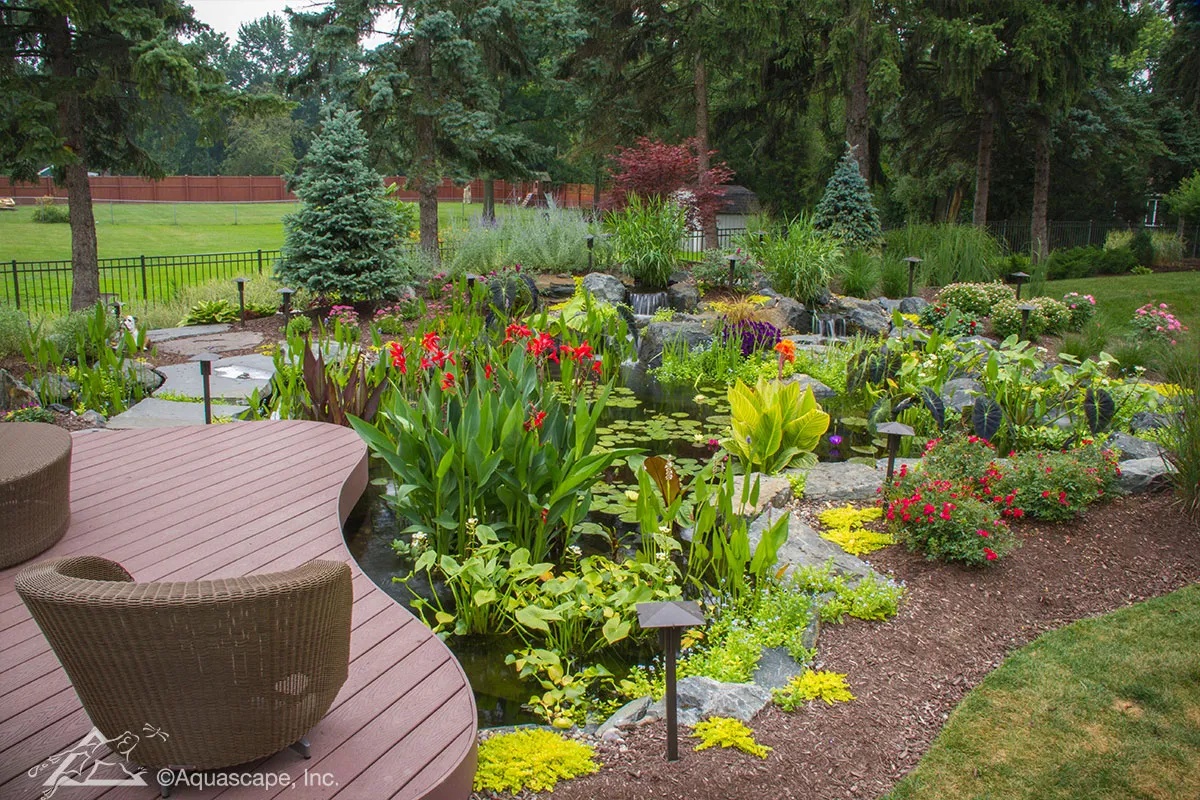
A mature ecosystem pond in full balance: waterfall running, lilies and marginals thriving, water clear enough to read the bottom. Photo: Aquascape, Inc.
The short answer
An ecosystem pond stays clear because it is a complete little food web in a lined basin. The pump keeps water moving through a skimmer and a biological filter. Beneficial bacteria living on the rocks, gravel, and filter media convert fish waste into plant food. Plants consume that food before algae can. Fish complete the cycle and keep insect larvae in check. Remove any one piece and the others have to work overtime, which is why ecosystem ponds are designed as a system, not a collection of parts.
The five working parts
1. Circulation: the pump and plumbing
Moving water is the pond's heartbeat. A pump sized to turn the pond over roughly once an hour pulls water across the surface into the skimmer and pushes it up to the biological filter, where it returns over the waterfall. On most of our builds that pump is a solids-handling model like the AquaForce 3600, because a pond pump has to pass what the pond produces without clogging. Circulation keeps oxygen up, prevents stagnant corners, and delivers waste to the filters instead of letting it settle and rot on the bottom.
2. Mechanical filtration: the skimmer
The skimmer is a box at the pond's edge that surface water flows into, the way a pool skimmer works. Leaves, pollen, seeds, and floating debris land in its basket and net before they can sink and decay. You empty the basket, the pond never has to digest all that material, and the pump sits protected inside the skimmer housing. Most of the clarity people notice in an ecosystem pond starts right here, with debris removed before it becomes waste.
3. Biological filtration: the BioFalls and wetland bacteria
The waterfall filter (a BioFalls on most of our builds) is packed with filter media holding enormous surface area, and that surface area becomes housing for beneficial bacteria colonies. These bacteria run the nitrogen cycle, explained below. The same bacteria colonize every rock and piece of gravel in the pond, which is why the rockwork is functional equipment, not decoration.
4. Plants: the pond's nutrient crew
Aquatic plants are not just pretty. Water lilies shade the water, which keeps it cooler and less inviting to algae. Marginal plants around the edges and floating plants on the surface absorb dissolved nutrients directly, the same nutrients algae would otherwise eat. A well-planted pond starves algae out of a job. In our climate, hardy lilies and marginals come back every spring, and the pond looks better in year three than year one as they fill in.
5. Fish, rocks, and gravel: the living and the foundation
Fish complete the food web. Koi and goldfish graze on algae, eat mosquito larvae before they ever become mosquitoes, and their waste feeds the bacteria-and-plant cycle. Rocks and gravel protect the liner from sun and punctures, give the pond its natural look, and, most importantly, provide the square footage bacteria need to colonize. A gravel bottom is not a dirt trap in a properly filtered pond. It is the largest piece of filtration in the system.
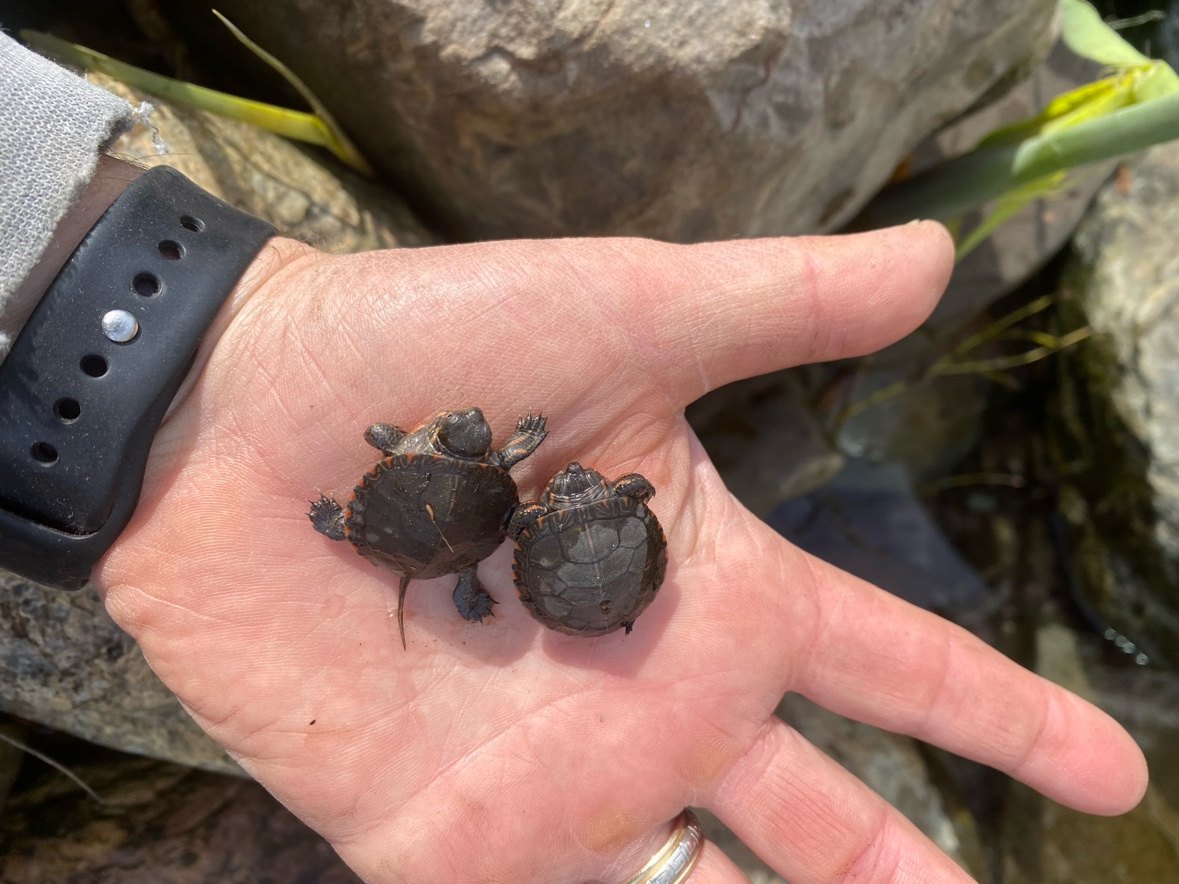
Baby painted turtles, some of the welcome wildlife an ecosystem pond supports. Photo: Sunrise Aquatics.
The nitrogen cycle, in plain English
This is the engine under everything:
- Fish produce waste, and uneaten food decays. Both make ammonia, which burns fish and feeds algae blooms.
- Beneficial bacteria convert ammonia into nitrite, then other bacteria convert nitrite into nitrate.
- Nitrate is plant food. Your lilies and marginals absorb it and grow.
- The result: water that tests clean, fish that stay healthy, and algae that cannot get a foothold because the plants ate first.
A new pond needs a few weeks for bacteria colonies to establish, which is why we seed new systems with pond starter bacteria and stock fish gradually. Patience in month one buys years of easy water.
Why ecosystem ponds stay clear without constant work
Traditional pond keeping fights the pond: chemical clarifiers, complete water changes, pressure-washed sterile gravel, algaecide cycles. An ecosystem pond works the other direction. Debris is skimmed before it decays, waste is converted instead of accumulating, and plants outcompete algae for food. The pond still needs you, just in small regular doses instead of emergencies, which is the maintenance rhythm below.
What knocks an ecosystem pond out of balance
- Overfeeding. The number one cause of green water we see on service calls. Uneaten food is pure ammonia. Feed what fish finish in a few minutes, and stop feeding below 50 degrees (a Smart Pond Thermometer takes the guesswork out of that call).
- Too many fish. Every fish is a waste factory. A pond balanced for six koi will struggle with sixteen.
- Too few plants. A new pond with bare shelves has nothing eating nitrate; algae volunteer for the job.
- Skipping the skimmer basket. A full basket lets debris bypass into the pond, and the decay load lands on the bacteria all at once.
- Lawn runoff and fertilizer. Rain washing fertilizer or grass clippings into the pond is a nutrient flood no balanced system can absorb.
- Killing the bacteria. Pressure washing all the gravel sterile, or cleaning filter media with chlorinated tap water, evicts your workforce and restarts the cycle. Our spring cleanout process is built around cleaning the pond without firing the bacteria.
The maintenance rhythm that keeps it working
- Weekly in season: empty the skimmer basket, top off the water level, and add beneficial bacteria per the label. Ten minutes, coffee in hand.
- As needed: trim dead plant growth, net out debris after storms, and check that the waterfall flow looks right.
- Spring: an annual cleanout, done April through May, before the pond fully wakes up. Here is how to decide between a partial and full cleanout.
- Fall: net the pond, cut plants back, and set up aeration and a de-icer for winter. Our fall pond closing guide walks through it step by step.
- Winter: aerator and de-icer on, waterfall off in a fish pond. Moving waterfall water superchills the pond and mixes away the warmer layer at the bottom where your fish rest.
FAQ
Do ecosystem ponds need a bottom drain?
No. In an ecosystem pond the skimmer handles surface debris continuously and the gravel's bacteria process what settles, so a bottom drain is unnecessary. Bottom drains belong to a different style of pond keeping, formal koi tanks with external filtration rooms.
Will a pond attract mosquitoes?
A working ecosystem pond is mosquito control, not a mosquito source. Mosquitoes need still water to breed; your pond has constant circulation, and the fish actively hunt larvae. It is the forgotten bucket and the clogged gutter that breed mosquitoes, not a running pond.
How much work is an ecosystem pond, really?
About ten minutes a week in season: skimmer basket, water top-off, bacteria dose. Plus one spring cleanout and one fall closing a year, which many of our customers hand to us. If a pond needs weekly water changes and constant chemicals, something in the system is missing, and that is fixable.
Can my existing pond be converted to an ecosystem pond?
Usually, yes. Most conversions add or upgrade the skimmer and biological filtration, add proper rock and gravel if the pond is bare liner, and build up the plantings over a season. The liner and basin you already have are often perfectly good bones. A consultation visit is how we tell you honestly what yours needs.
Why not just use algaecide when the water turns green?
Because green water is a symptom, not the disease. Algaecide kills the algae, the dead algae decays, and the nutrient load that caused the bloom is still there waiting, so the bloom returns and the cycle repeats all summer. Balancing the system removes the cause. We reach for treatments like pond sludge remover packs to support the biology, not replace it.
Built as a system, or not at all
Every pond we build at Sunrise Aquatics is an ecosystem pond, sized and balanced as one system: skimmer, BioFalls, circulation, rock and gravel, plants, and fish all matched to each other and to the yard it lives in. That is the Aquascape method, and as a Certified Aquascape Contractor and authorized Aquascape retailer, it is the only way we build. If you are dreaming about a pond, or fighting one that was built as a tub instead of a system, book a consultation and we will walk your yard and talk honestly about what it takes.