Pond Cleanout: When and Why Your Pond Needs One
By Brent Bivona, Certified Aquascape Contractor and owner of Sunrise Aquatics, Macedon, NY. Building and servicing ponds in the Rochester and Finger Lakes region since 1996.
Most ecosystem ponds benefit from an annual spring cleanout. A professional pond cleanout removes a winter's worth of sludge, leaves, and waste before it can foul your water, and it is the one time each year your whole pond, liner, rocks, filter, and fish get a close inspection. This guide covers when to do it, what we look for, the cleanout process step by step, and how to decide whether a partial or full cleanout is right for your pond.
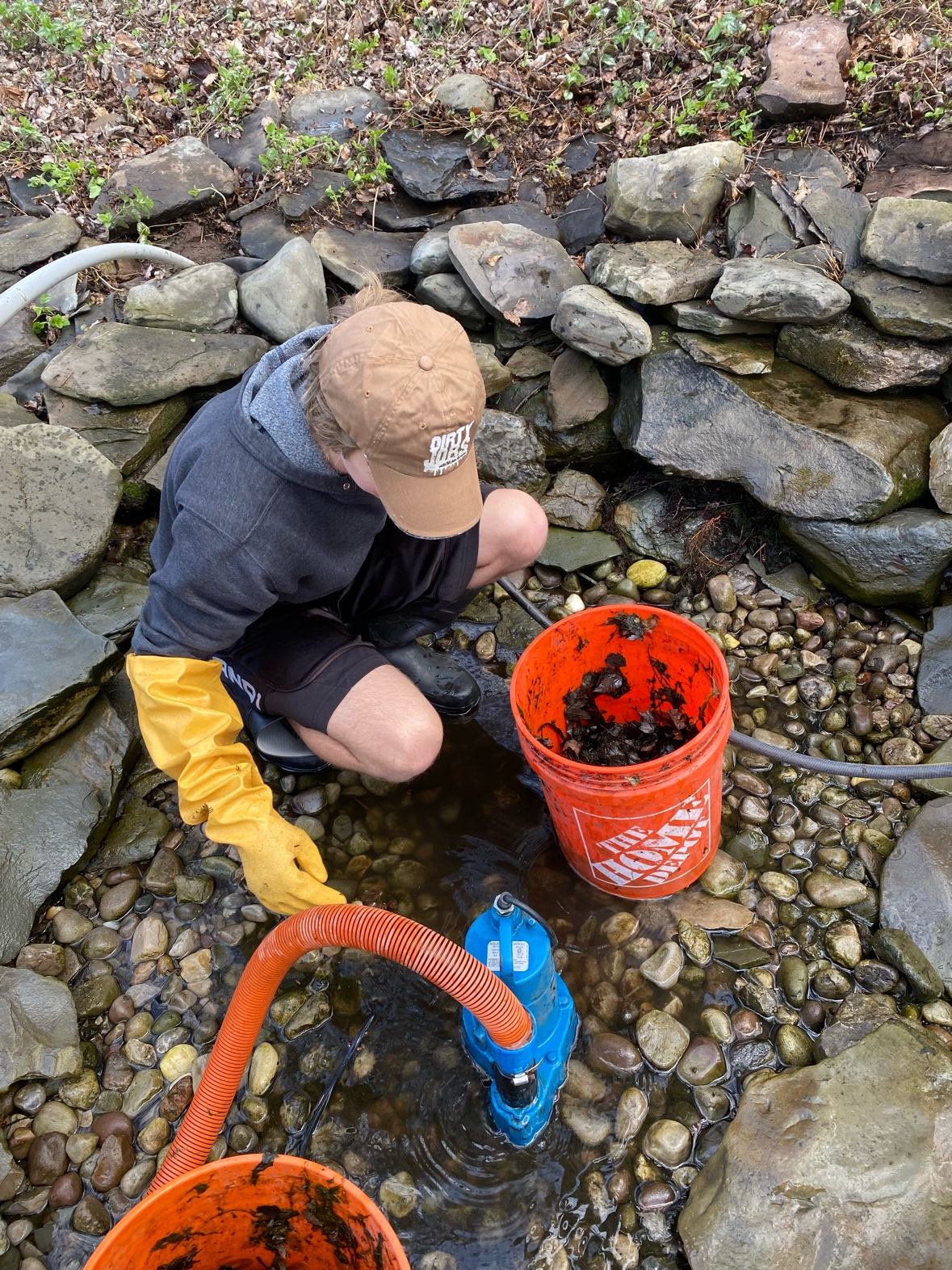
The unglamorous heart of a cleanout: pond draining, and a winter's worth of leaves and muck coming out by the bucket. Sunrise Aquatics cleanout work, Rochester region.
The short answer
Do your pond cleanout in spring, once the ice is out and water temperatures are climbing through the 40s and into the 50s. Our cleanout season in the Rochester and Finger Lakes region runs April through May, while the pond is waking up but before algae gets a head start. That window is not a hard deadline either: we sometimes do cleanouts later in the season for people who missed the spring, bought a home with a pond, or have a pond that cannot wait. A later cleanout done carefully beats skipping the year entirely. Choose a full cleanout if your pond has heavy sludge, a big leaf load, lots of fish, or was skipped last year. Choose a partial cleanout if the pond was well maintained, the bottom is fairly clean, and last year's full cleanout is still holding up. Either way, the goal is the same: start the season with clean water, a healthy filter, and fish that were handled gently and put back fast.
Why an ecosystem pond needs a spring cleanout
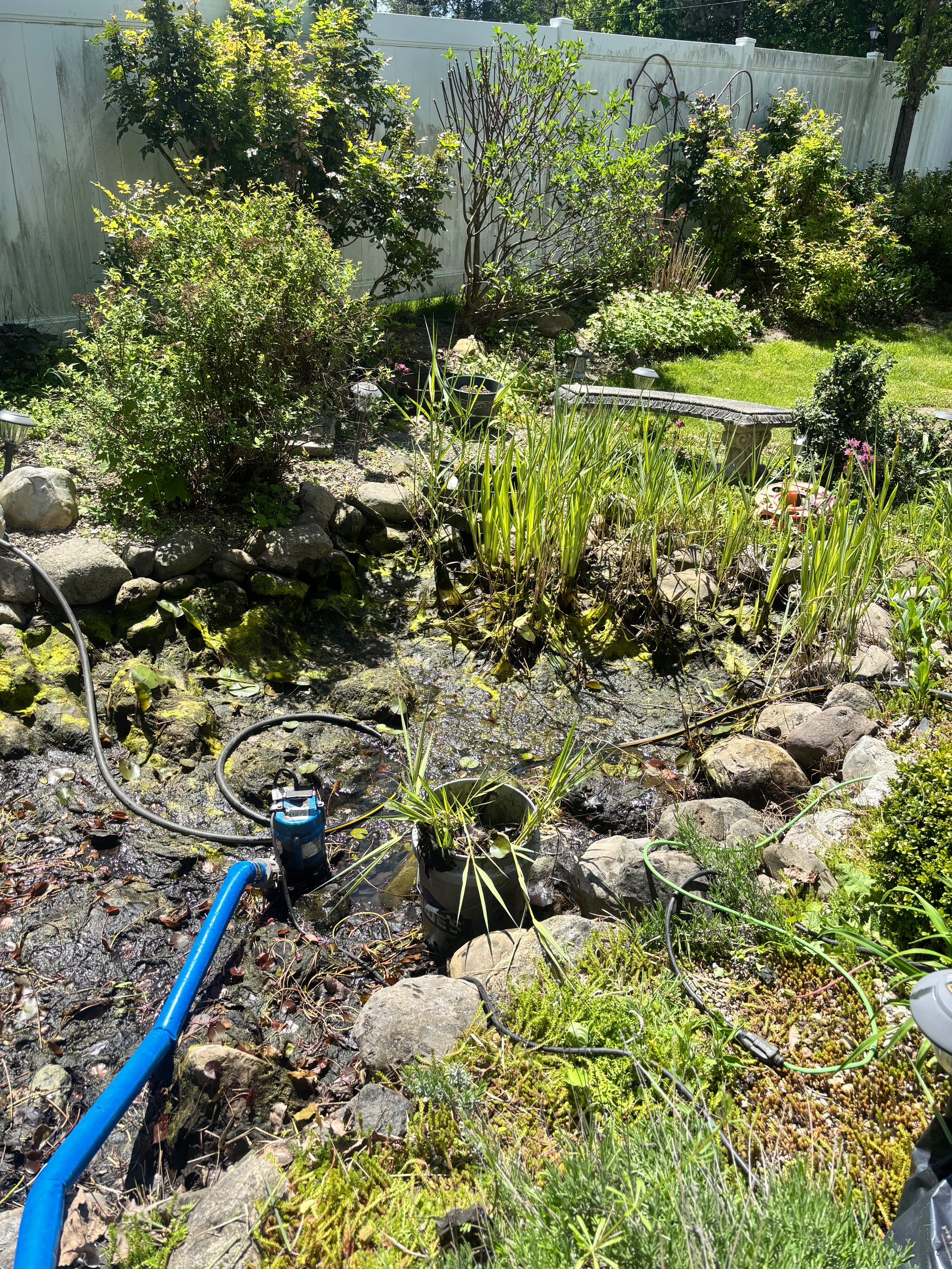
This is what a winter leaves behind: algae-matted rock and a season of sludge. A spring cleanout is how it starts the year clean instead.
An ecosystem pond is a living system, not a swimming pool. All winter, even under the ice, leaves break down, fish produce waste, and organic muck, called sludge or mulm, builds up on the bottom. Your skimmer and biological filter handle the daily load during the season, but they cannot remove what has settled into the gravel over five months of winter.
A spring cleanout resets the system:
- It removes the ammonia source. Decaying sludge releases ammonia as water warms. Taking it out in spring prevents the water quality crash that hits ponds in April and May.
- It beats the algae. Sludge is fertilizer. Remove it before the water warms and you starve the string algae and green water that explode in neglected ponds.
- It is a health check for your fish. The cleanout is the one time each year every fish gets seen up close, when early ulcers, parasites, or injuries can be caught while they are still treatable.
- It protects the equipment and liner. We find the shifted rocks, exposed liner edges, worn pump parts, and tired filter media in spring, when fixing them is cheap, instead of mid-season, when it is not.
- It makes the whole season easier. A pond that starts clean stays balanced longer, needs fewer treatments, and looks the way you built it to look.
When exactly? Watch the water, not the calendar
In Western New York, our cleanouts run April through May, which lines up with the window between ice-out and the pond hitting about 55 to 60 degrees:
- Too early (ice still on, water in the 30s): miserable working conditions and no benefit. The bacteria you add afterward will not be active yet.
- Just right (water in the 40s and 50s): fish are still slow and easy to handle gently, bacteria products start working, and you finish before algae season.
- Later in the season (water in the 60s and up, string algae growing): not ideal, because the pond is fully awake and the fish are active, but sometimes it is necessary, and we do take cleanouts later than May when a pond needs one. We just take extra care: work in the cooler part of the day, keep the holding tank shaded and aerated, and get the fish back as fast as possible.
If your pond was closed properly in the fall, netted with the pump stored and aeration running, spring timing is forgiving. If it went into winter full of leaves, do not let the cleanout slide. That pond needs to be first on the list.
What we look for during a cleanout
A cleanout is part cleaning, part inspection. On every job we check:
- Sludge depth on the bottom and in the planting pockets. This is the main factor in the partial versus full decision.
- Fish health: body condition after winter, fins, any sores, ulcers, or signs of parasites.
- Liner and edges: exposed liner, low edges where water can escape, shifted edge rock.
- Rock and gravel: collapsed areas, gravel that has migrated or thinned.
- Plants: water lilies and marginals that need dividing, dead growth to remove, pots that floated or tipped.
- Filtration: skimmer basket and net condition, filter mats, and biological media that is compacted or worn.
- Pump and plumbing: flow rate compared to last year, worn fittings, anything that froze or cracked over winter.
- Water loss: a pond that lost water all winter tells us to hunt for the low edge or leak while it is drained, not after it is refilled.
Partial or full cleanout: how to decide
This is the question we get most, and the honest answer is that not every pond needs the full treatment every year.
A partial cleanout is right when:
- The pond had a full cleanout last spring
- Sludge on the bottom is light, a thin layer, not inches
- The pond was netted in the fall, so the leaf load is small
- Fish load is modest and water stayed clear last season
- The filter and skimmer are in good shape
A partial cleanout means no full drain and the fish stay in the pond. We net out debris, vacuum the bottom, clean the skimmer and filter, rinse the media, trim the plants, and do a partial water change. It is faster, gentler, and costs less.
A full cleanout is right when:
- Sludge is deep, an inch or more in spots, or the bottom has never been cleaned
- The pond went into winter un-netted under trees
- Fish load is heavy, or fish showed health problems
- Water quality fought you all last season
- The pond was skipped last year, or you just bought the house and do not know its history
A full cleanout means draining the pond, moving the fish to a holding tank, washing the rock and gravel, and inspecting everything bare. It is the reset button, and for a pond in rough shape it is the only honest option. Skipping it and treating symptoms with chemicals costs more by July than the cleanout would have.
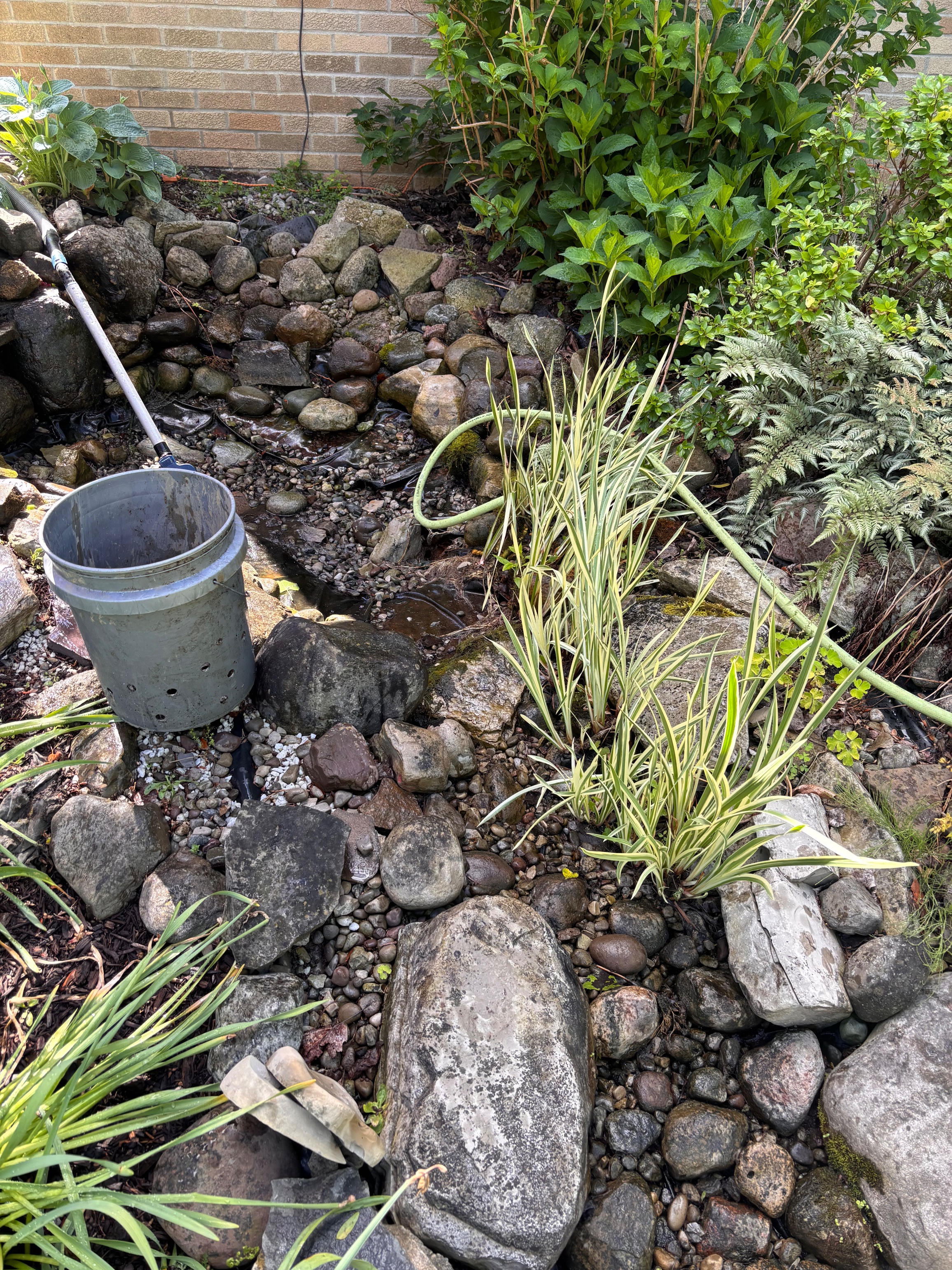
Drained down and opened up: stream, gravel, and all, ready for washing and inspection.
The full cleanout process, step by step
This is the order we work in, and the order matters, mostly because of the fish.
- Set up the holding tank first. A stock tank or portable pool, filled with the pond's own water, with an aerator running and a net cover ready. Fish go into water they already know, which keeps stress down.
- Drain the pond partway and catch the fish. As the water drops, fish collect in the deep end where they are easy to net calmly. Every fish gets a quick look as it moves to the holding tank.
- Finish draining. The dirty water goes to your garden beds or lawn where it can, it is full of nutrients plants love.
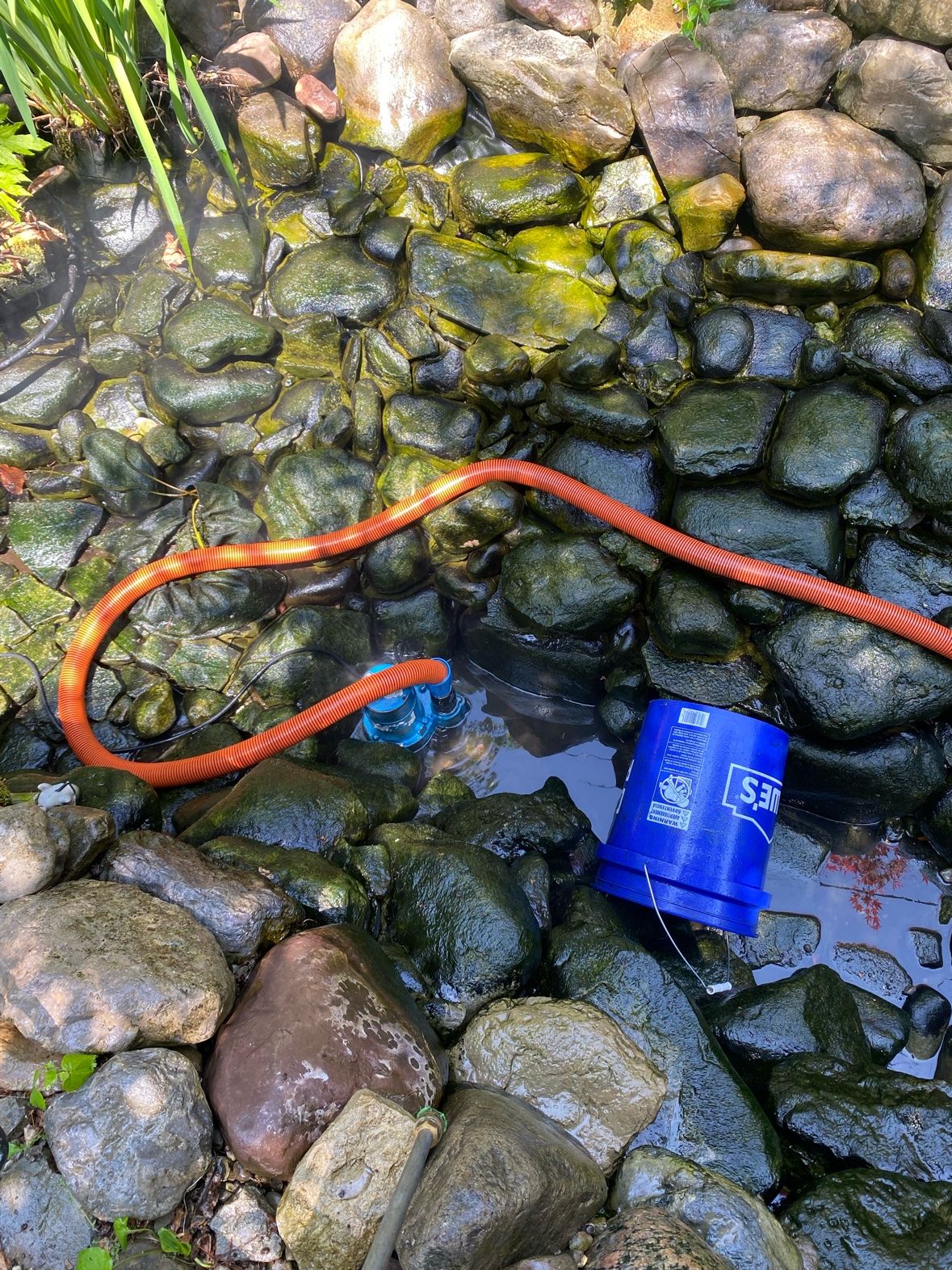
The cleanout pump at work in the shallows, pulling the pond down so the rock and gravel can be washed.
- Wash the rock and gravel. Working from the top down, we pressure wash the rocks and rinse the gravel, pumping the dirty rinse water out as we go. The goal is clean rock and open gravel, not a sterile pond. A thin biofilm stays, and that is good, it helps the pond re-balance fast.
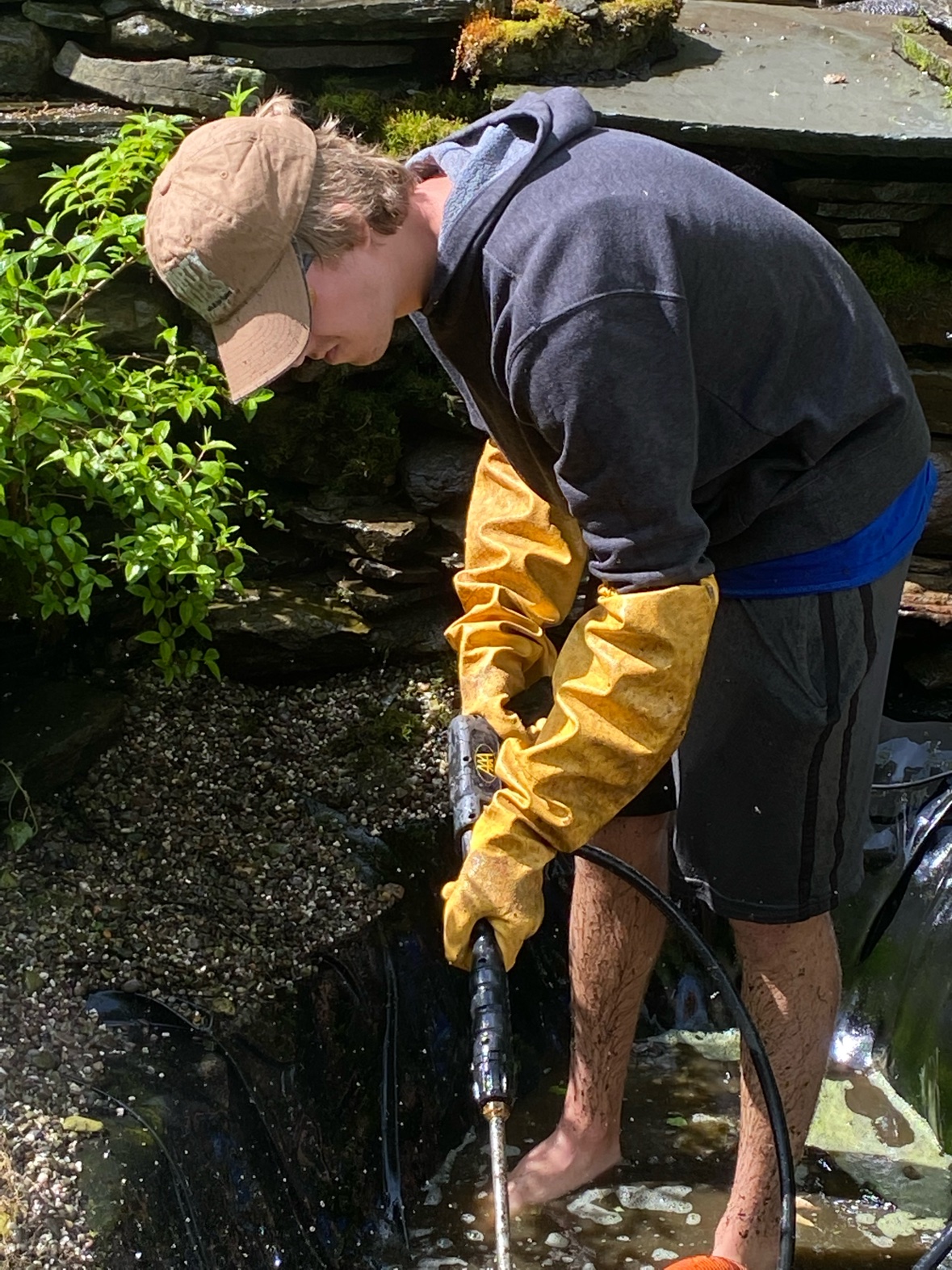
Washing down the rockwork. Everything gets rinsed, nothing gets sterilized, the good biofilm stays.
5. Clean the skimmer and biofilter. Baskets and nets out, filter mats rinsed, biological media rinsed in removed pond water, never blasted with chlorinated tap water.
6. Plant work (optional extra). Cutting off dead growth is part of every cleanout. Dividing crowded lilies, repotting, and fertilizing is an extra service we offer as an add-on when it is booked ahead and time on the route allows. We do not always have time for it on a standard cleanout day, so if your lilies need dividing, ask when you book, not when we arrive.
7. Inspect everything while it is empty. Liner, edges, lights, plumbing, pump. This is the cheapest moment of the year to fix any of it.
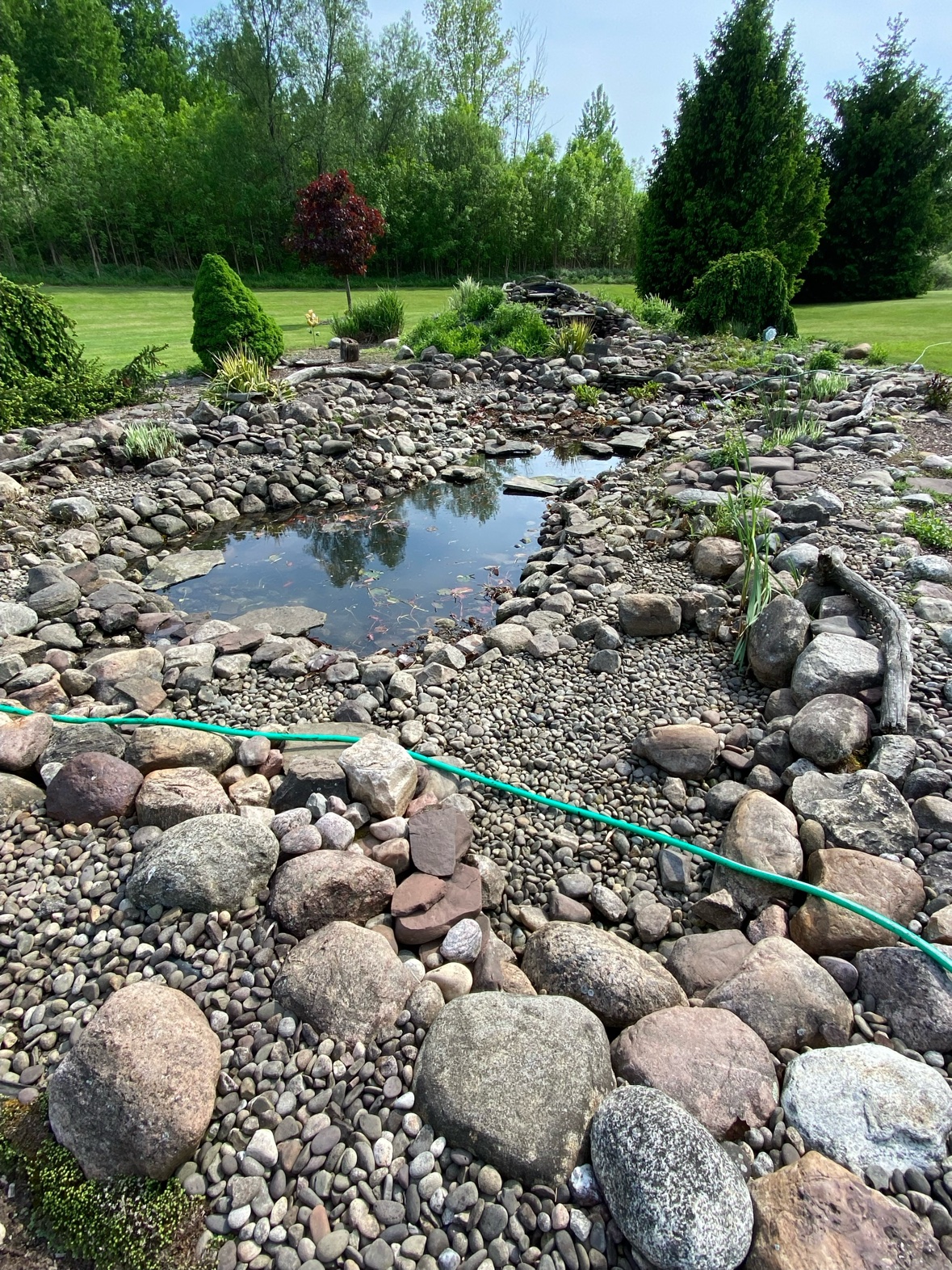
A full cleanout with the pond drained: every rock, edge, and the liner get inspected before the refill. Most problems are found, and fixed, right here.
8. Refill, and treat the new water. Fresh fill water gets a pond detoxifier treatment to make it safe for fish, neutralizing chlorine and chloramines. Then cold water beneficial bacteria goes in, because in early spring the water is still cold and regular bacteria is not awake yet. A pond starter bacteria boost helps re-seed the filter as temperatures climb, and a sludge remover treatment digests whatever the washing could not reach.
9. Bring the fish home carefully. Holding tank water and pond water are matched for temperature, then fish are moved back, usually within the same day. The aerator in the holding tank runs the whole time, and the tank stays shaded and covered, because a fish that jumps out is the one risk we never take.
From start to finish, a full cleanout on an average backyard pond takes a few hours, and the fish spend as little of it in the tank as we can manage.
Five cleanout mistakes we see every spring
- Sterilizing the pond. Scrubbing every rock bare and pressure washing the liner clean destroys the biofilm the pond needs. Clean the muck out, leave the biology alone.
- Rinsing filter media with a garden hose. Chlorinated tap water kills the beneficial bacteria living in your media. Rinse in pond water, always.
- Skipping the year because spring got away from you. Early spring is best, but a cleanout in May, or even later with proper fish care, is far better than letting deep sludge sit for another full year.
- Skipping the detoxifier on refill. Straight tap water with chlorine or chloramines can burn gills. Every refill after a full cleanout gets treated, no exceptions.
- Doing a partial when the pond needs a full. If the sludge is deep, a light vacuum just stirs it. The water looks better for two weeks and worse by June.
What about pondless waterfalls?
Pondless features have no fish and no open pond, so the job is smaller: a spring flush of the basin, pump inspection, filter and intake cleaning, and a check of the reservoir and plumbing for winter damage. It is still worth doing annually, because the basin collects the same sludge, just out of sight.
FAQ
How often does a pond need a cleanout?
Most ecosystem ponds benefit from one every spring. Well balanced ponds with good fall care can alternate, a full cleanout one year and a partial the next. Ponds under heavy trees or with big fish loads usually need the full cleanout every year.
Will a cleanout hurt my fish?
Done properly, no. Fish go into a shaded, aerated holding tank filled with their own pond water, they are handled gently, and they are back the same day. The stress of a careful cleanout is far less than the stress of a spring ammonia spike in a dirty pond.
Can I do my own pond cleanout?
A partial cleanout, yes, many of our customers handle that themselves and we stock what they need. A full cleanout is heavier work: you need a holding tank, an aerator, a cleanout pump, and a pressure washer, plus the eye for liner and fish problems. Many people have us do the full one and handle partials themselves in between.
When is the best time for a pond cleanout in Rochester, NY?
April through May is our cleanout season, once the ice is out and water temperatures are in the 40s and 50s. Book early, because every pond in the region wants those same weeks. If you missed the spring window, call anyway: we sometimes do cleanouts later in the season, and a later cleanout with extra care for the fish still beats skipping the year.
Do the fish have to come out for a partial cleanout?
No. In a partial cleanout the fish stay in the pond, we work around them, and the water level only drops partway for the water change.
What does a pond cleanout cost?
It depends on the size of the pond, how much sludge and leaf load it carries, and whether it needs the partial or full service. The honest way to price it is to look at the pond, which is why we start with the pond itself, not a phone quote. You can send a pond cleaning request with your pond's details and we will follow up with timing and next steps.
Want us to handle your spring cleanout?
Sunrise Aquatics has been cleaning and opening ponds across the Rochester and Finger Lakes region since 1996, and as a Certified Aquascape Contractor we clean ecosystem ponds the way they were designed to be cleaned: thorough on the muck, gentle on the biology, and careful with your fish. Book your pond cleaning before the spring calendar fills, because once the ice is out, every pond owner in Western New York calls in the same two weeks.
Have a blessed day, and here is to a clean start this spring.