How to Close Your Pond for Winter in Western New York: The Complete Fall Winterization Guide
By Brent Bivona, Certified Aquascape Contractor and owner of Sunrise Aquatics, Macedon, NY. Building and servicing ponds in the Rochester and Finger Lakes region since 1996.
Proper fall pond closing and winterization is what protects your koi, your equipment, and your biological filter through a Western New York winter. This guide walks through every step, in the order we do it on service calls, so your pond opens clean and healthy in the spring.
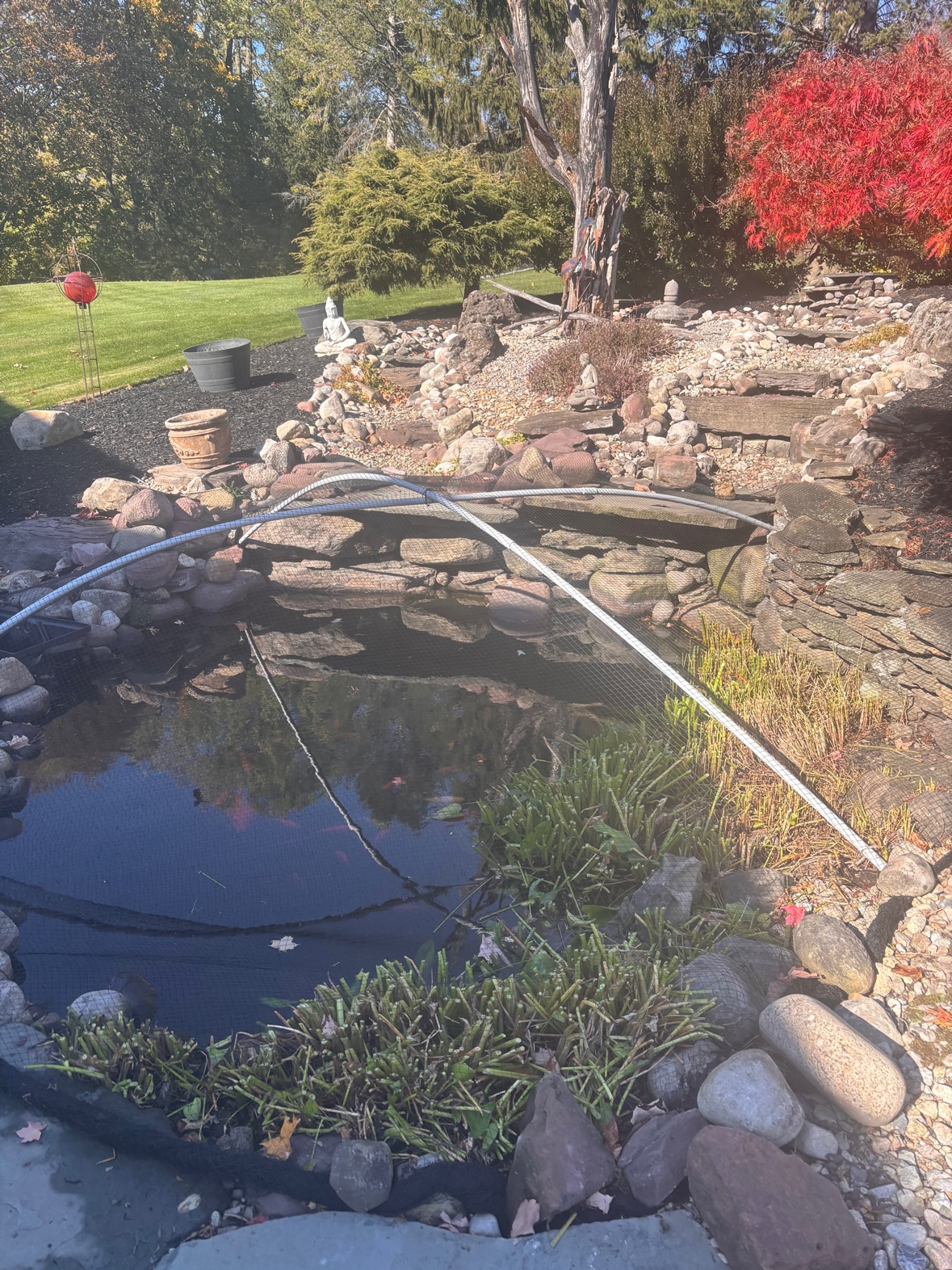
A fall closing done right: the net is tented above the water so leaves stay out, plants are cut back, and the koi are settled in for winter. Sunrise Aquatics service work, Rochester region.
The short answer
Close your pond when nighttime temperatures regularly drop into the 30s and daytime highs stay in the 50s, which in the Rochester and Finger Lakes region is usually mid to late October. The core steps are: stop feeding fish below 50 degrees, net the pond before the leaves fall, clean out debris and cut back plants, do a partial water change with cold water beneficial bacteria, protect your biological filter, shut down and store the pump, and keep a hole in the ice all winter with an aerator and a de-icer. Do not wait for the first hard freeze. Once ice forms, every step gets harder.
When should you close a pond in Western New York?
Timing is temperature, not the calendar. Watch the water temperature, not just the air:
- Water in the 60s: Start reducing feeding. Begin netting if your trees drop leaves early.
- Water in the 50s: Switch fish to a wheat germ based cold water food. Do your cleanup, water change, and plant cutback now.
- Water at 50 degrees and falling: Stop feeding entirely. Finish equipment decisions and get aeration and de-icing in place.
- First hard freeze: Everything should already be done. In our region that can arrive fast, sometimes late October, sometimes November.
If your pond sits under heavy tree cover, start a week earlier than your neighbors. Leaves, not cold, are what ruin most ponds over winter.
What you need for fall pond winterization
- Pond netting and stakes or tent poles
- Cold water beneficial bacteria (formulated to keep working below 50 degrees)
- Sludge and muck remover for the pond bottom
- Wheat germ based fall fish food
- A pond aeration kit, sized to your pond
- A floating pond de-icer
- Pond thermometer
- Pruners for plant cutback, a pond vacuum or net for debris
- A bucket for storing your pump, if it comes out
Every item on this list is a product we use on our own service routes. You can find them in our shop at sunriseaquatics.com, and we are happy to size the aerator and de-icer to your pond before you buy.
Step 1: Net the pond before the leaves fall
Cover the pond with pond netting as soon as leaves start dropping, before the big fall. Keep the net tented slightly above the water surface so leaves rest on top and can be shaken off, instead of soaking in the water.
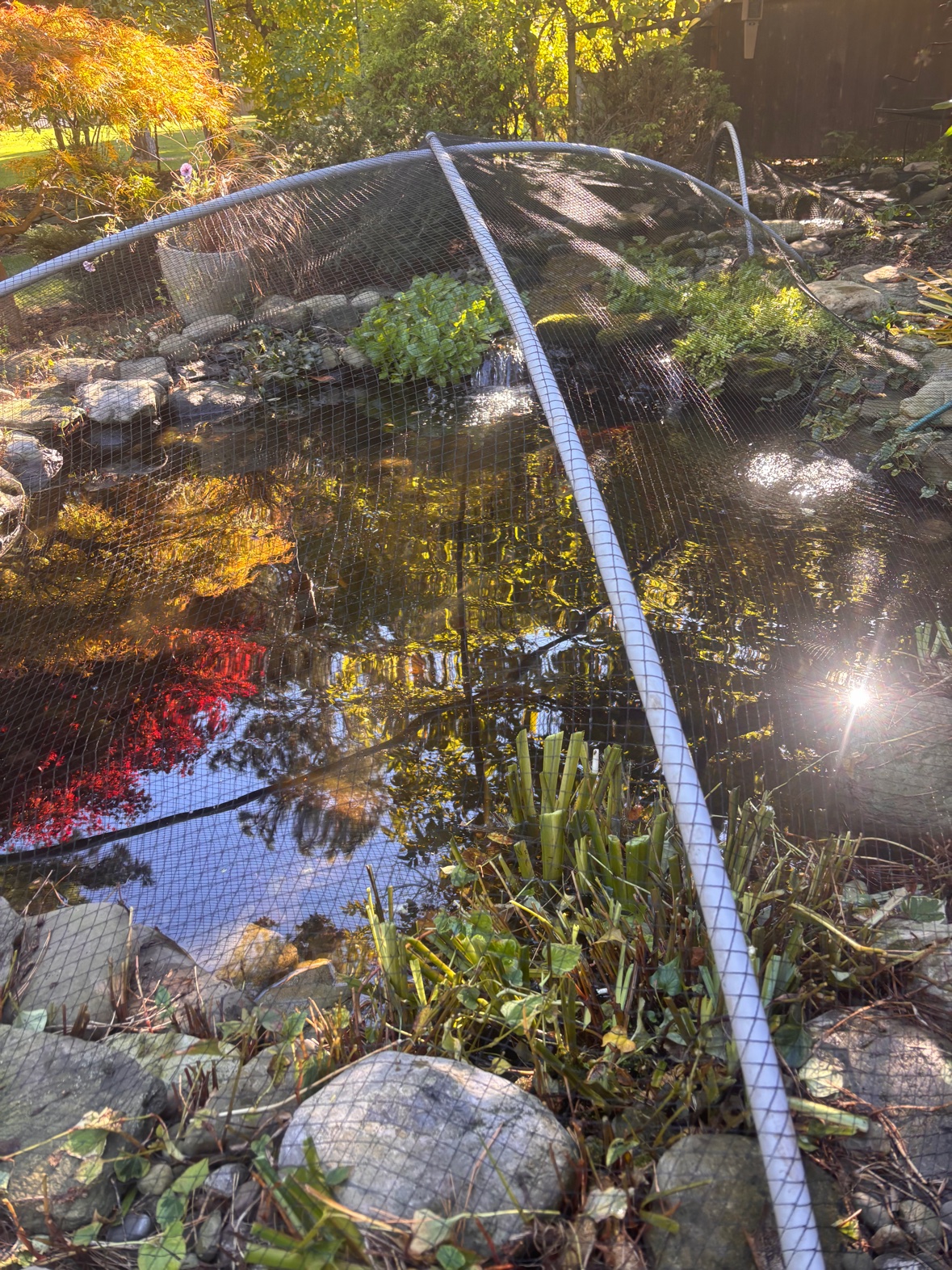
Up close: the net rides on a simple hoop frame above the surface, and the marginal plants along the edge are already cut back for winter. Rotting leaves are the number one cause of spring water quality problems: they break down all winter, release ammonia and tannins, and feed the algae bloom you fight in April. An hour with a net in October saves days of cleanup in spring.
Step 2: Clean the pond and cut back the plants
- Net or vacuum out leaves, sludge, and debris from the bottom. Less organic waste going into winter means less ammonia coming out of it.
- Cut hardy marginal plants and water lilies back to a few inches above their crowns and drop the pots to the deepest part of the pond, below the freeze line.
- Remove tropical plants. Tropicals will not survive a Western New York winter in the pond. Compost them, or overwinter favorites indoors in a tub of water in a bright spot.
- Clean out the skimmer basket and check the skimmer net one last time.
Step 3: Partial water change and cold water treatments
Do a partial water change of about 20 to 25 percent. Then dose with cold water beneficial bacteria. Regular beneficial bacteria goes dormant in cold water, but cold water formulas keep working below 50 degrees, breaking down leaves and waste all winter long. If sludge has built up on the bottom, add a sludge remover treatment as well. If your pond battled algae all summer, fall is the time to get ahead of it, not spring, when everything wakes up at once.
Step 4: Feed right, then stop feeding
Fish digestion slows as water cools, and uneaten food fouls the water fast. Follow the water temperature:
- Above 60 degrees: Regular feeding is fine, only what fish finish in about five minutes.
- 50 to 60 degrees: Switch to a wheat germ based food. It is easier to digest in cool water.
- Below 50 degrees: Stop feeding completely until spring. Your fish will not starve. Their metabolism slows down and they live off stored energy, which is exactly what they are built to do in a New York winter.
Step 5: Protect your biological filter
Your biofilter is a living colony of beneficial bacteria, and how you treat it in the fall decides how fast your pond cycles in the spring.
- Rinse filter media, including BioBalls and filter mats, in a bucket of pond water. Never hose media down with chlorinated tap water, and never scrub it sterile. You are rinsing off debris, not removing the bacteria.
- If you shut your waterfall filter down for winter, drain it so standing water cannot freeze and crack the housing. Store removable media somewhere it will not freeze solid, like a garage or basement.
- If your system is a pondless or fish-free feature that runs all winter, check that the filter and plumbing are insulated from the coldest exposure and keep an eye on them after deep freezes.
Step 6: Shut the pump and waterfall down
For a pond with fish in Western New York, our recommendation is clear: shut the waterfall down and pull the pump for winter. This is a fish safety issue, not just an equipment one.
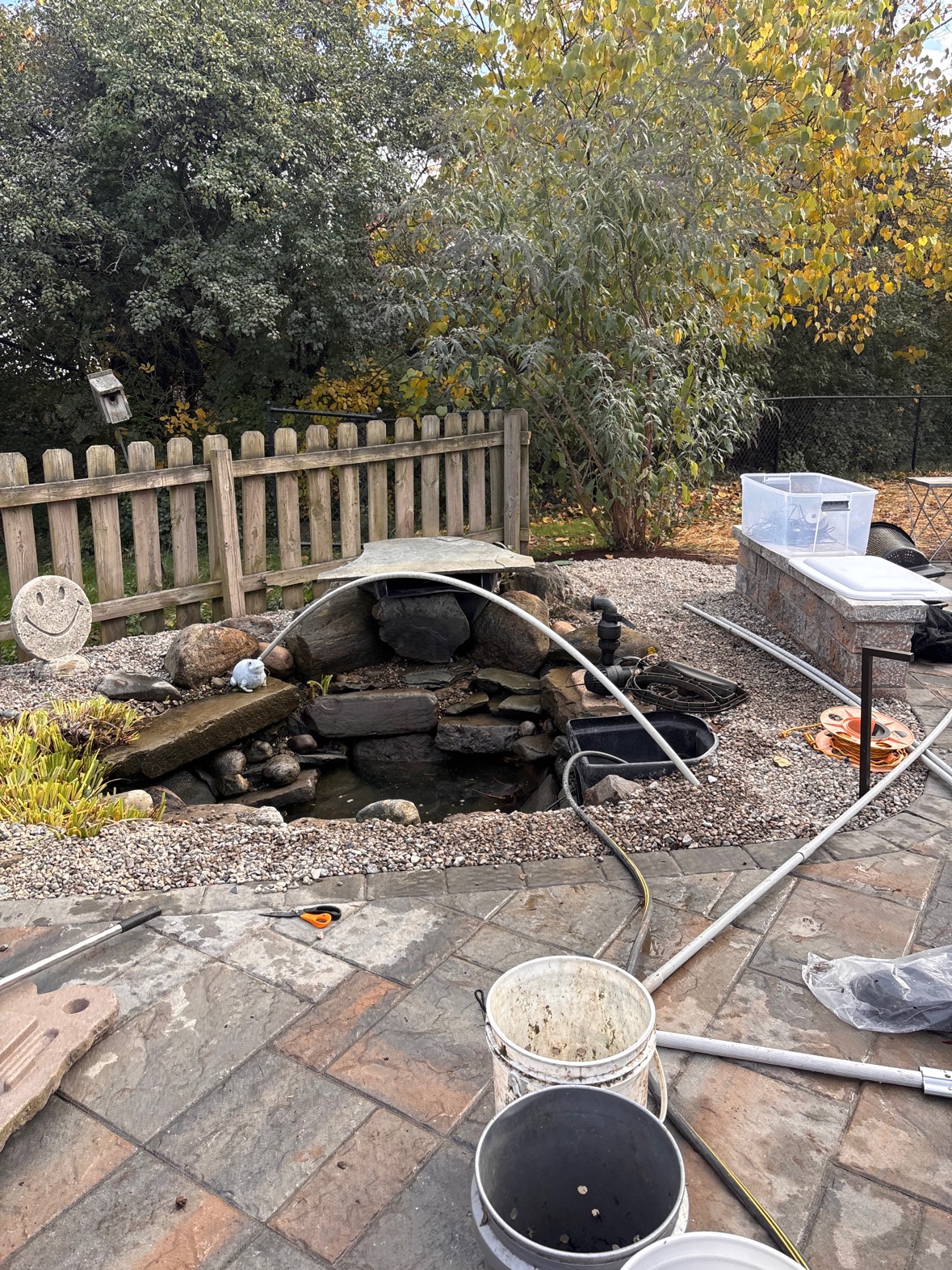
A closing in progress: pump out and draining before storage, net frame going up. This is the step that protects both the equipment and the fish.
Here is why. In winter your pond settles into layers, and the warmest water, around 39 to 40 degrees, sits at the bottom. That is where your fish rest, and that stable warm layer is what carries them through. A running pump and waterfall destroy it. The waterfall drags that warm bottom water up and over cold rock in freezing air, chills it, and mixes the whole pond toward one cold temperature. In a hard cold snap the water temperature can swing fast, and that combination of superchilled water and sudden temperature change stresses fish badly and can kill them. Add the risk of an ice dam quietly diverting water out of the pond, and running the waterfall is a gamble we do not take with customers' fish.
- Clean the pump, then store it in a bucket of water in a basement or garage where it will not freeze. Storing it wet keeps the seals from drying out and cracking, which is the most common cause of spring pump failure we see.
- Drain exposed plumbing lines and pull UV clarifiers and pressurized filters. Drain them, clean them, and store them where they cannot freeze and crack.
- Your fish do not lose anything with the waterfall off. The aerator and de-icer in the next step do the real winter work, keeping oxygen moving and a hole in the ice, without stirring up the warm layer at the bottom.
- Pondless waterfalls and fountains with no fish are the exception. Running those through winter is a looks decision, covered below, as long as you check for ice dams.
Step 7: Aeration and a hole in the ice
This step is non-negotiable in Western New York. When ice seals the pond surface, gases from decomposing waste cannot escape and oxygen cannot get in. That is what kills fish in winter, not the cold itself.
- Place a pond aerator with the air stone or diffuser on a shallow shelf, about 6 to 12 inches below the surface, not on the deep bottom. You want to move the surface water and keep gas exchange going without supercooling the deep water where your fish are resting.
- Add a floating de-icer to guarantee an open hole even in the coldest stretches. The de-icer is a backup, not the main system. It only needs to keep a small opening, so place it near the aerator.
- Check the opening after deep freezes. If ice ever seals over completely for more than a few days, act.
Step 8: Final check before freeze-up
Walk the pond once more: net secure, aerator bubbling, de-icer floating and plugged in, water level topped off, tropical plants out, hardy plants down deep. Take a photo of your setup. If anything looks off in January, that photo helps you, or us, spot what changed.
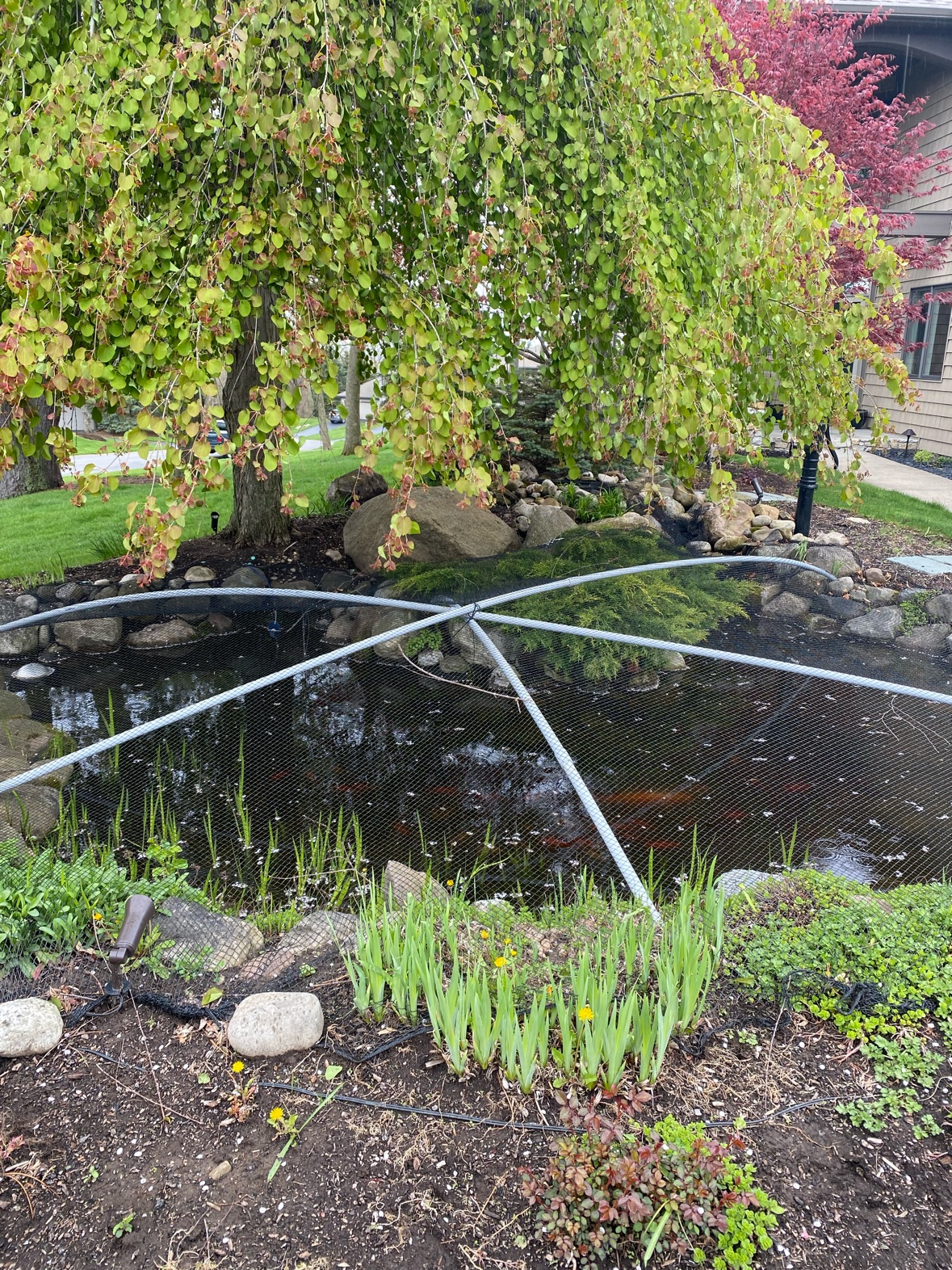
Closed and ready: net tented over the pond, koi settled underneath. This is what the final check should look like.
Pondless waterfalls and fountainscapes
No fish changes the job, but does not eliminate it. For pondless waterfalls, most owners shut the pump down, pull it, drain the lines, and store the pump in water as described above, though a pondless system can also run through winter if you commit to checking for ice dams. For fountainscapes and decorative fountains, drain and cover the basin or bring smaller features indoors. Standing water freezing inside a decorative piece is what splits them.
The six mistakes that kill fish and crack equipment
- Smashing ice to open a hole. The shock waves can injure or kill fish. Melt a hole with a pan of hot water set on the ice instead.
- Shutting everything off and walking away. The waterfall should go off, but the aerator must stay on. No gas exchange under sealed ice is the top winter fish killer in our region.
- Running the waterfall all winter with fish in the pond. It superchills the water, wipes out the warm bottom layer your fish depend on, and a fast temperature swing can kill them.
- Feeding below 50 degrees. Uneaten food rots, and fish cannot digest properly in cold water anyway.
- Draining the pond completely. An empty liner through a New York freeze and thaw cycle shifts, wrinkles, and can crack or pull out of place.
- Cleaning the biofilter like a pool filter. Sterilized media means your pond starts spring with no bacteria colony, and the ammonia spike hits right when your fish are weakest.
What happens if you skip fall closing?
The pond does not usually fail in November. It fails in March and April: green water, ammonia problems, sick fish, a pump with cracked seals, and a cleanup that costs more than the closing would have. Nearly every rough spring opening we are called to traces back to a skipped fall, not a bad winter.
FAQ
When should I close my pond in Rochester, NY?
When nighttime lows regularly reach the 30s and water temperature falls through the 50s, typically mid to late October in the Rochester and Finger Lakes area. Finish before the first hard freeze.
Should I run my pond pump all winter?
No, not in a pond with fish in our climate. A running waterfall superchills the water and mixes away the warm layer at the bottom where fish overwinter, and sudden temperature swings can stress or kill them. Shut the pump down, clean it, and store it in a bucket of water where it will not freeze. Use an aerator and a de-icer for winter instead. Pondless features with no fish are the exception.
Do I need both an aerator and a de-icer?
Yes, in Western New York we recommend both. The aerator does the daily work of gas exchange, and the de-icer guarantees an open hole during deep freezes when aeration alone may not keep up.
How deep does a pond need to be for koi to survive winter?
At least 18 inches in the overwintering area, and 24 inches or deeper is better for koi in our climate. Fish rest in the deepest water, which stays the warmest.
When do I stop feeding koi in the fall?
Switch to a wheat germ food when water is in the 50s, and stop feeding entirely below 50 degrees until spring water temperatures climb back above 50.
Can I leave my pond netting on all winter?
Yes. Leave it on until the trees are bare and leaf fall is done, then you can remove it or leave it until spring cleanup. Just make sure leaves are not left sitting in the water underneath it.
What is cold water beneficial bacteria, and do I need it?
It is a bacteria blend formulated to stay active below 50 degrees, when regular bacteria goes dormant. It breaks down leaves and waste through the winter, and yes, for a pond with fish in our climate it is worth using.
Need a hand with your closing?
Sunrise Aquatics has been closing ponds across the Rochester and Finger Lakes region since 1996, and as a Certified Aquascape Contractor we close every pond the way Aquascape designs them to be closed. If you would rather hand the whole job off, you can book your fall pond closing with us before the freeze. And if you just want the right aerator, de-icer, netting, and cold water treatments sized for your pond, shop the fall and winter products we use on our own routes in our online shop.
Have a blessed day, and here is to a clean spring opening.